
ERC? Whose bright idea was that?
The key to this story is a pub. Fittingly, it’s called The Beach. It’s always occupied the corner at the seaward end of Victoria Road and since the commercial dock turned into destination real estate, aka Exmouth Marina, it’s catered for a very different clientele but back in the day it was first and favourite port of call for local fishermen, stevedores, thirsty locals plus a rich mix of foreign seaman spending a night or two tied up in the shadow of the grain silos before shipping back home. Russians, Scandinavians, Poles, and an assortment of matelots from across the Channel crowded the bar to change money, down pints of cloudy cider, and charm the local women.
‘It was a fabulous pub,’ says ERC secretary Bob Board. ‘There was this wild mix of languages, and accents, and stories from home ports. Exmouth took in animal feed from the continent and timber from Norway and whole boatloads of Russian peat. In return, we exported all sorts – grain, milk powder, cheese – plus metal shavings we called swarf that went in bulk to Spain. That stuff was everywhere, all over the dockside, and unless you were careful it ruined your shoes. The place was really buzzing, especially the pub. One way or another, we all owed our livings to the sea and believe it or not there was never any trouble.’
Bob himself had spent seven years at sea before settling down in his native Exmouth and founding a truck business ferrying goods from the dock inland. He ran nearly a dozen lorries but by the end of the Eighties coastal ships were getting bigger and bigger, threatening to outgrow the narrow dock entrance. ‘The docks finally closed in 1989,’ says Bob, ‘By that time I’d given up the truck business and settled for being one of the Dockmasters. I had seven years in the job which gave me the skills to get something similar down in Teignmouth, but my heart was still across the water in Exmouth.’ And in the Beach pub, which is where Exmouth Rowing Club finally made its debut.
‘It happened around what we now call The Captain’s Table,’ recalls Bob. ‘Four local guys, Andy Herbert, Steve Charles-Davis, Wallace Sunley and Austin Riley decided it might be fun to lay hands on a boat and go for a row when it took their fancy. Only two of them really knew what they were doing but they put £500 apiece into the kitty and managed to buy a Flashboat, a big heavy wooden old thing they called ‘the Dug Out’. They kept it in the Buoy Store at the end of Camperdown Terrace and hauled it into the water when the weather and the tides felt right.’
More than two decades later, ERC’s first-ever boat would end up on the greensward opposite the Ocean Centre, and became Exmouth’s biggest flowerpot. They called it Wallace, after one of the founding fathers who later became ERC Treasurer, and some of the older club members sometimes remembered to give the geraniums a drop or two of water.
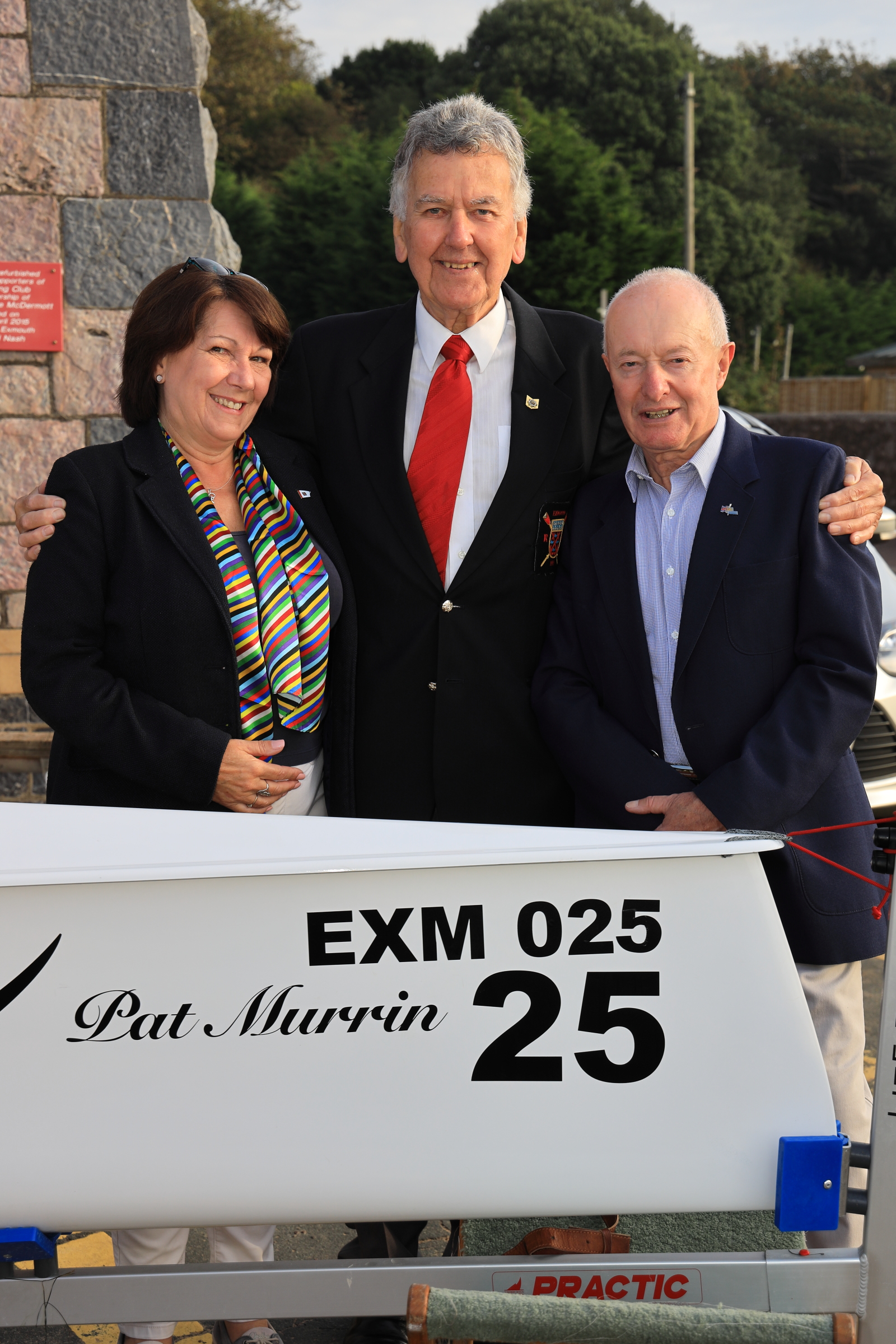
Photo (left to right: Karen Brice, Keith Murrin and Bob Board)
But the craic around The Captain’s Table had bred some serious ambitions, and the call went out for additional boats. One of the Founding Four had connections in northern France, and from L’Aberach came the offer of two sweep-oar boats, once again constructed in wood.
‘They were great,’ says Bob. ‘Really beamy, loads of room, heavy to launch and to row but they had staggered seats and it was easy to move around so they were ideal for training beginners. We agreed a price and fetched them back on the ferry from Roscoff. The chalets on what we called Shelly Beach were being demolished ahead of the marina build and we were able to store the boats on waste ground near Belchers Slip. We were having monthly management meetings in the Beach by now, and the membership had definitely got to double figures but what I remember best was how informal everything was. There was no talk of Ergo times or training schedules and it was rare to risk the open sea but there was plenty of water in the river, though we never launched without a bucket and a brush. I lost count of the times we ran aground on sandbanks on a falling tide, but our boats were famous up and down the river for their clean bottoms.’
It was at this point that the ever-swelling membership felt the spur of competition, and one of the first regattas took them – and their two French boats – back to L’Aberach.
‘That was a great event,’ says Bob. ‘The locals made us really welcome but there was a language problem in both directions. On the day of the race, the conditions were getting worse by the minute and in the end the course seawards to the turn-buoy was shortened but no one thought to tell us because no one spoke English and we didn’t understand a word of French and so we kept hauling and hauling. I remember a big old trawler out to sea. It kept disappearing behind these huge waves but on we went regardless until it dawned on us that there was no one else in the race. At that point, we turned round and told ourselves the star prize was surviving. Great night, though. Really enjoyed it.’
Back in Exmouth, elders in the rowing club had laid hands on a Portacabin. The council were happy to offer a site near the water for a modest rent, and the first Ergo appeared. ‘By now we had twenty to thirty members,’ says Bob, ‘and we were starting to compete against other local clubs. We knew we didn’t have the history and heritage of fine-boat outfits like Exeter and Totnes but that never seemed to matter. Then came the opportunity to move down the seafront to a site behind the old Lifeboat Station. One or two of us had always dreamed that one day it might make the perfect clubhouse but getting onto the compound behind it was, for the time being, enough.’
And so the Portacabin, complete with souvenir photos and the odd trophy, was craned onto a flatbed truck and settled on its new foundations. The slipway onto the beach was a spit away and there was plenty of room for a growing fleet of quads. ‘We’d been back to France,’ says Bob, ‘And bought a couple of Safrans. The fact that they’re still in service, still afloat, tells you a great deal about the quality of French designs, and they became our secret weapon when we got serious about competing, and even more serious about winning.’
Under the captainship of Brian O’Dea, ERC began to attract eager young apprentice rowers. The top junior crew became ‘The Fellowship’, the Portacabin was dubbed ‘The Sweatbox’, and the trophies from event after event began to clutter its gamey interior.
By now, ERC had stepped into the new millennium and it was obvious to the Founding Fathers that times had changed. ‘To make a mark in coastal rowing,’ says Bob, ‘you have to take it seriously, and that’s exactly what’s happened. We’ve been lucky with grant funding. £50,000 from Sport England allowed us to move into the Lifeboat Station itself, and since then – 2015 – the club has been transformed. We have facilities that are the envy of other coastal clubs. We have one of the finest and most challenging stretches of water in the kingdom. No one thinks twice about going out to sea. But what has been severed was that link that once found us all together in the pub. We made our living from the ocean. We knew about its funny ways. We respected it. Don’t get me wrong. ERC is still a safe club, still a happy club, and now a very successful club, but in those days we didn’t have to worry about rules and regulations, about health and safety, about swim tests and insurance schedules and all the rest of it. Rowing was something much simpler. We were kids at heart and we just loved messing about in boats. And so we put Wallace in the water, sniffed the wind, got our feet wet, and off we went. Fabulous. Just fabulous.’